The remarkable evolution of bowling scoring—from handwritten score sheets and illuminated glass to computers, video monitors, and connected entertainment systems.
When Every Bowling Game Needed a Scorekeeper
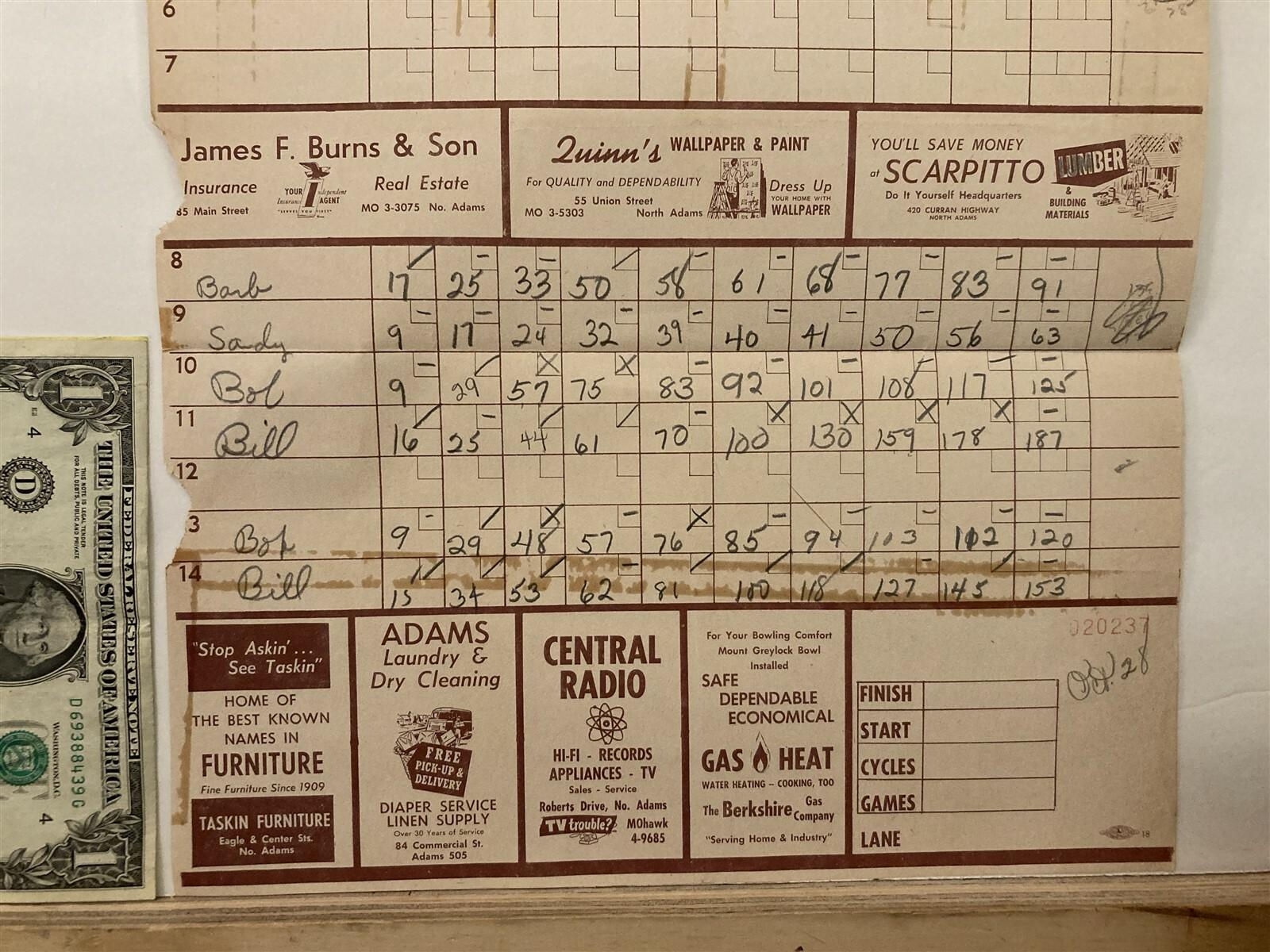
For much of bowling’s history, keeping score required three things: a score sheet, a pencil, and someone who understood the rules.
As modern tenpin bowling became standardized in the late nineteenth century, scores were recorded frame by frame. Strikes and spares made the arithmetic more complicated than simply counting fallen pins. A strike required the next two deliveries to determine its bonus; a spare required the next delivery.
Experienced bowlers learned to calculate scores themselves. Others relied on a designated scorekeeper.
The arrangement was inexpensive and reliable, but it had disadvantages. Players could make mistakes, scorekeepers could fall behind, and spectators often had no convenient way to follow the game.
The first great technological change didn’t eliminate the scorekeeper. It made the scorekeeper’s work visible to everyone.
The 1930s: The Search for a Better Scoreboard
As bowling centers became larger and more popular, a practical question emerged: Why should a scorekeeper’s work remain hidden on a little sheet of paper?
Inventors began applying optical projection technology to bowling.
One of the earliest documented efforts came from James E. Bancroft, whose August 16, 1939, patent application described a projector specifically suited to displaying bowling scores.
Bancroft proposed an illuminated scoring table, a transparent scoring sheet, and an arrangement of lenses and mirrors that would project an enlarged image onto a screen.
His invention also addressed an optical problem: without careful design, projected writing could appear reversed or inverted.
The scorekeeper needed to see the score normally, and so did the audience.
Bancroft’s patent, issued July 22, 1941, provides valuable evidence of how early bowling projection equipment was conceived.
And it answers a fascinating question: What exactly did the scorekeeper write on?
The patent described transparent material such as Celluloid or Cellophane, marked with ink or crayon. The writing was illuminated from below and projected onto the overhead screen.
In other words, these early designs were not simply shining a projector at an ordinary paper score sheet. They could use a transparent, illuminated scoring surface remarkably similar to a classroom overhead projector.
John B. Coker and the Tel-E-Score
Another important pioneer was John B. Coker, an inventive California bowling-industry figure who would eventually enter the United States Bowling Congress Hall of Fame.
Coker had already developed an electronic foul detector in 1937.
According to his USBC biography, a bowling proprietor subsequently challenged him to develop a system that would allow players and spectators to see scores as games progressed.
Coker developed preliminary plans and sought assistance from scientists at the California Institute of Technology.
The result became known as the Tel-E-Score.
Coker and Harold G. Fitz Gerald filed a patent application on July 8, 1940, for a score-projecting apparatus. The patent was issued October 5, 1943.
Bancroft’s 1939 patent application predates the 1940 Coker–Fitz Gerald application. Coker, however, is specifically credited by USBC with developing the Tel-E-Score.
Their design placed the scorekeeper at a console facing the lanes. The scorekeeper wrote on a transparent sheet resting on a glass surface. A lamp beneath the surface illuminated the writing, while lenses and mirrors projected it onto an elevated screen.
The patent even describes the arrangement of the scoring cabinet, its cooling fan, and the overhead projection components.
The system accomplished something enormously important: spectators could follow a bowling game without depending on a separate manually updated scoreboard.
The Tel-E-Score made the display possible, but a human still did all the work.
The 1940s and 1950s: Overhead Scoring Becomes Familiar
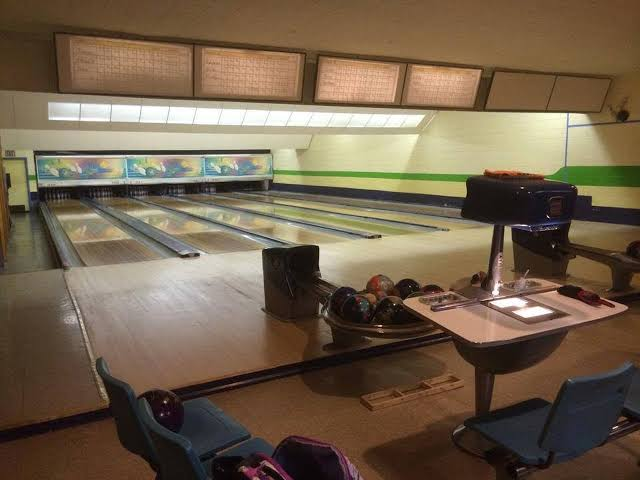
During the decades following these early inventions, projected scoring became a recognizable feature of bowling centers.
A scorekeeper could write on a transparent surface, and the score would appear above the lane almost immediately.
The method was especially useful in league bowling, where several players and spectators might want to follow the standings.
Projection also made the scoring experience more theatrical. Instead of consulting a sheet at the table, bowlers could look up at a large illuminated display.
These systems still had their shortcomings. Projection lamps generated heat, optical components required adjustment, and handwritten scores depended on the scorekeeper’s accuracy.
And there was one problem the projector could never solve: someone still had to do the mathematics.
That would require a very different kind of machine.
The 1960s: From Transparent Sheets to Paper Projection
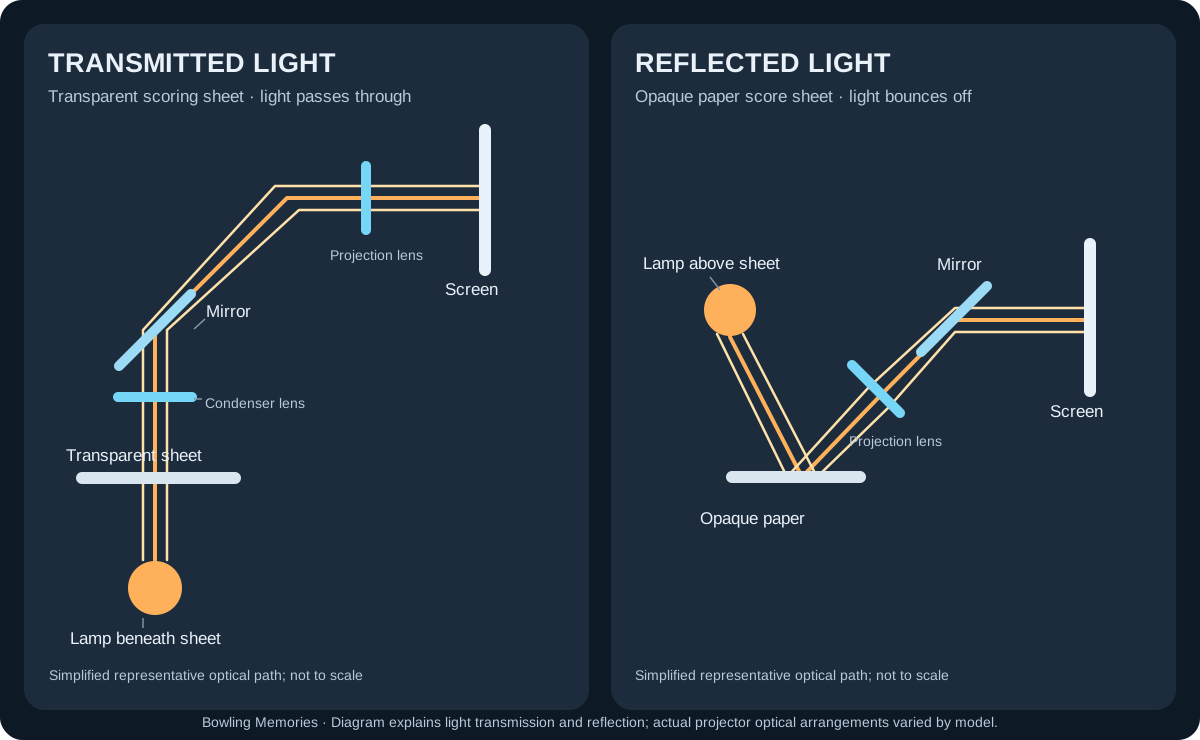
Early overhead scoring systems depended on transparent scoring sheets illuminated from beneath. But another approach emerged: projecting an image of an ordinary paper score sheet using reflected light.
Instead of shining light through a transparent surface, a reflective projector directed light onto an opaque scoring sheet and captured the reflected image through its optical system.
The distinction might sound minor, but it changed the scorekeeper’s working environment.
With a reflective system, scores could be written directly on ordinary paper. There was no need to prepare a transparent scoring sheet or use a writing surface designed to transmit light.
A particularly useful historical example appears in Ernest C. Webb’s 1966 patent for a Bowling Score Projector.
Webb filed his application on June 6, 1962. The patent, issued June 28, 1966, described a system that projected images from opaque scoring sheets rather than requiring transparent materials.
Its optical arrangement illuminated the score sheet and directed the reflected image through lenses and mirrors to the overhead display.
The underlying principle was similar to the opaque projectors used in classrooms and offices: a brightly illuminated original could be projected without being transparent.
For bowling centers, this offered another way to combine familiar handwritten scoring with large overhead displays.
And it represents an important chapter in bowling technology: the movement from specialized transparent scoring surfaces toward the projection of conventional written records.
Neither method eliminated the scorekeeper. Both made the scorekeeper’s work easier for everyone to see.
The 1960s: Brunswick Automates the Arithmetic
The next major breakthrough came from Brunswick.
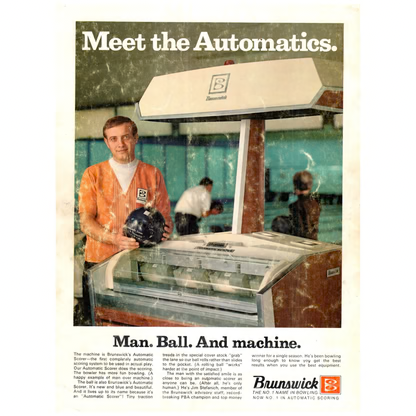
On November 8, 1967, Brunswick publicly introduced its Automatic Scorer at Village Lanes in Chicago, Illinois.
The presentation attracted industry professionals, media representatives, and accomplished bowlers, including Chicago bowling figure Paul Krumske.
Unlike traditional projected scoring, Brunswick’s machine could calculate bowling scores automatically.
Its computing mechanism recorded scoring information, determined frame totals, and produced a projected score display. It could also print a completed score sheet.
This was a transitional technology: electronic and electromechanical computation worked alongside a familiar projected scoring presentation.
The American Bowling Congress approved the system after a 2,000-game test.
Brunswick’s invention did not immediately eliminate every manual scorekeeper. The equipment was costly and complex, and bowling centers had to decide whether the investment was worthwhile.
Nevertheless, it demonstrated that a machine could perform the most troublesome part of keeping score.
The computer was entering the bowling alley.
The 1970s: AMF Enters the Competition
Brunswick’s breakthrough encouraged competition.
During the mid-1970s, American Machine and Foundry—better known as AMF—introduced its MagicScore automatic scoring system.
MagicScore calculated individual scores, maintained team totals, provided indicators showing whose turn came next, and could print completed score sheets.
The American Bowling Congress approved MagicScore in 1976.
AMF’s system represented another important step toward making automatic scoring practical and appealing to bowling-center operators.
Meanwhile, manufacturers and electronics companies experimented with alternative designs, including systems incorporating computer terminals and cathode-ray-tube displays.
The industry was beginning to move beyond projected paper-style scoring toward the electronic screens that would eventually become standard.
The 1980s and 1990s: The Video Scoring Era
As computers became smaller, more affordable, and more powerful, bowling scoring underwent another transformation.
Video monitors gradually replaced the older projection arrangements in newly equipped and modernized centers.
Rather than projecting writing or mechanically printed numbers, computers could generate the score display electronically.
Bowler names, frame totals, strike symbols, spare symbols, and team standings appeared directly on screens.
These systems also made corrections easier. A mistaken pinfall reading no longer necessarily required erasing a score sheet or manipulating a mechanical scoring device.
Bowling-center management functions increasingly became connected with scoring, including league information, handicaps, lane assignments, and tournament administration.
An important development came in 1993, when the Italian company Qubica began installing its computerized scoring technology. Qubica would later combine with AMF’s bowling operations to form QubicaAMF.
Scoring was becoming software.
The 2000s: Scoring Becomes Part of the Entertainment
By the early twenty-first century, automatic scoring was familiar to recreational and competitive bowlers alike.
The scoreboard was no longer merely a record of the game.
Animated strikes, colorful graphics, personalized messages, themed backgrounds, and increasingly sophisticated video presentations transformed the scoring screen into an entertainment feature.
Bowling-center operators could use connected scoring systems to help manage leagues, tournaments, casual bowling, lane rentals, and customer experiences.
The scoreboard had become part of the bowling center’s larger technological infrastructure.
Today: The Connected Bowling Center
Modern scoring systems can communicate with pinsetters, lane-control equipment, automatic bumpers, digital displays, and entertainment software.
Depending on the installation, the same system may support traditional league scoring, personalized recreational games, interactive projections, and specialized party experiences.
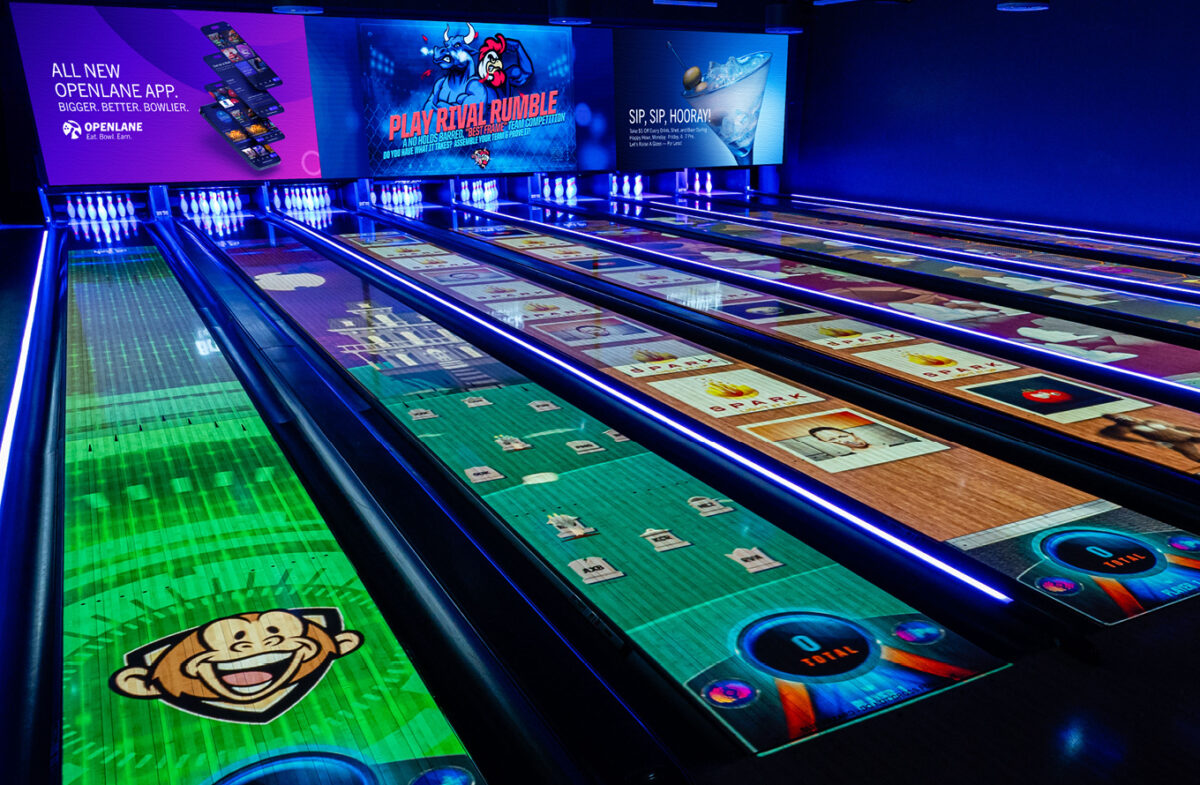
Automatic pinfall detection feeds scoring software, which calculates the results and presents them on displays that may be integrated into the center’s network.
The technology continues to evolve, particularly as bowling centers incorporate new pinsetter designs, projection systems, and interactive entertainment.
From a Pencil to an Entire Connected System
The history of bowling scoring is not simply the history of replacing paper with computers.
It is a succession of inventions addressing different problems.
Handwritten score sheets preserved the results. Illuminated transparent-sheet projection made them visible. Reflective projection allowed ordinary paper score sheets to appear overhead. Mechanical and electronic computing reduced the arithmetic. Video displays transformed presentation. Computer networks connected scoring to bowling-center operations. Modern software made the scoreboard part of the entertainment itself.
Each generation built upon the work of the one before it.
And somewhere near the beginning of that journey was a scorekeeper sitting beside a bowling lane, writing numbers onto an illuminated transparent sheet while a beam of light carried those numbers to a screen overhead.
That’s a piece of bowling history worth remembering.
Sources & Further Reading
Explore the original patents, museum records, and manufacturer histories behind this article.
Early projected scoring
- United States Bowling Congress — John B. Coker, Hall of Fame Biography ↗Coker’s Tel-E-Score, electronic foul detector, and work with Caltech scientists.
- James E. Bancroft — U.S. Patent 2,250,174, Projector ↗Filed August 16, 1939; issued July 22, 1941. Transparent scoring material, illumination, and optical projection.
- John B. Coker and Harold G. Fitz Gerald — U.S. Patent 2,330,799 ↗Filed July 8, 1940; issued October 5, 1943. Illuminated scoring console and overhead projection.
- Ernest C. Webb — U.S. Patent 3,257,898, Bowling Score Projector ↗Filed June 6, 1962; issued June 28, 1966. Reflected-light scoring projection.
The arrival of automatic scoring
- International Bowling Museum — Adding Automation ↗Brunswick’s 1967 Automatic Scorer and its testing.
- International Bowling Museum — Keeping Score with Krumske ↗Brunswick’s November 8, 1967, introduction.
- International Bowling Museum — The Science of Scoring ↗Early automatic scoring technology.
- Brunswick Corporation — Our History ↗Brunswick’s corporate history and automatic scoring developments.
- Brunswick Corporation — U.S. Patent 3,738,652 ↗Automatic Bowling Score Computing and Display Device; filed 1962, issued 1973.
- Brunswick Corporation — U.S. Patent 3,582,071 ↗Bowling Scoring System; filed 1967, issued 1971.
AMF and computerized scoring
- International Bowling Museum — Oh Oh It’s Magic ↗AMF MagicScore and its 1976 approval.
- QubicaAMF — The History of QubicaAMF Worldwide ↗Manufacturer chronology.
- Replay Magazine / QubicaAMF — A Benchmark of Bowling Breakthroughs (2019) ↗Historical overview of AMF and Qubica scoring developments.
Research note: The patents establish early technical designs, but this article does not attempt to describe or quantify the adoption of these technologies across all existing bowling centers. Centers using projected scoring existed alongside centers using video scoring, which in turn existed alongside centers using computerized scoring.